
Planetary Change and the New Geopolitics of the Anthropocene
Jahanara Jaba | 31 August 2026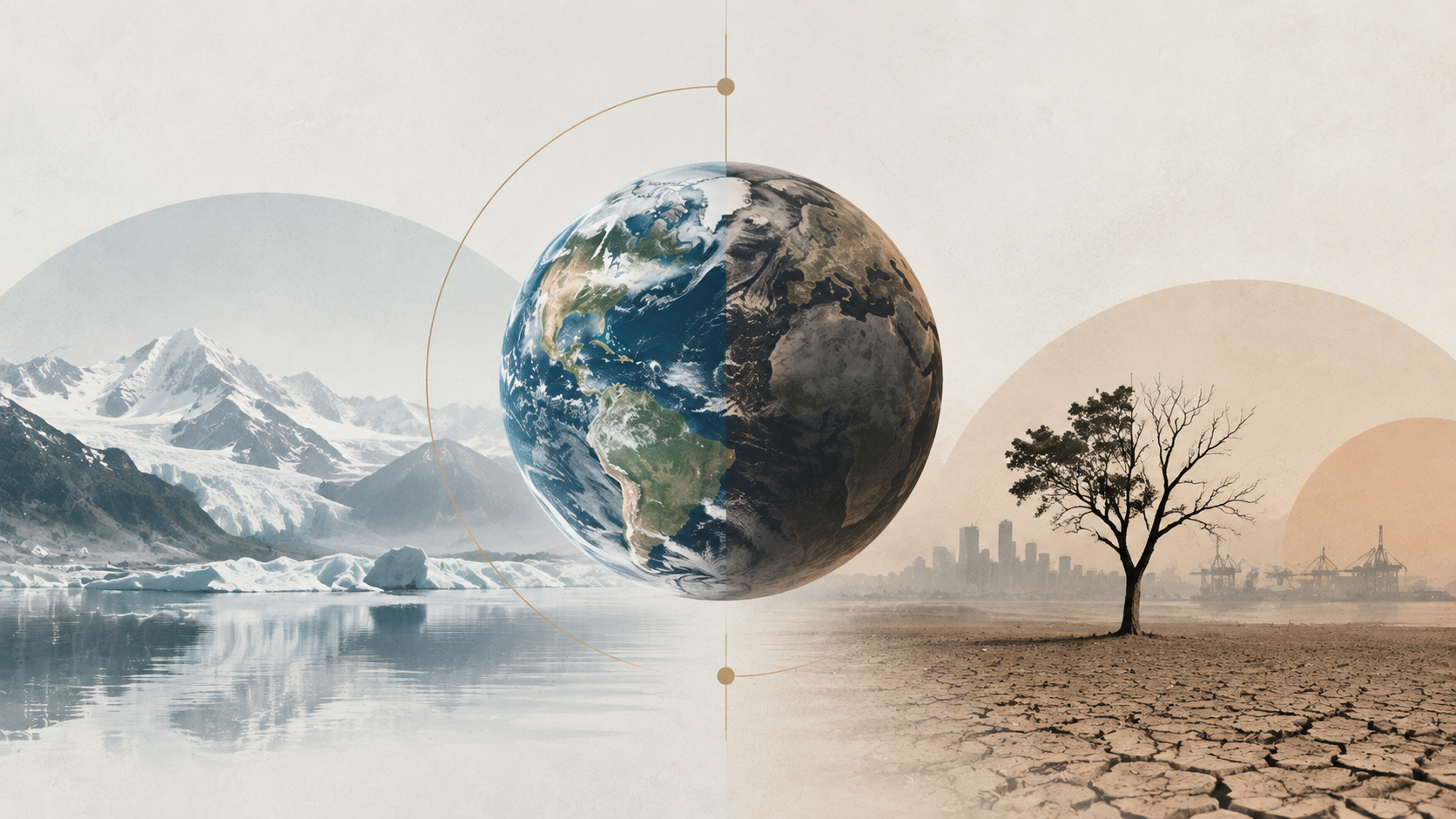
For much of human history, earthquakes, hurricanes, floods, and droughts were understood as powerful forces of nature that existed beyond human control. We could prepare for these calamities and attempt to recover from their consequences, but their occurrence was largely considered independent of human actions. However, when an earthquake, flood or hurricane strikes, the immediate images are often of collapsed buildings, rescue operations, and humanitarian suffering. Yet the consequences are rarely determined by geological forces alone. The same natural hazard can produce very different outcomes depending on governance capacity, institutional preparedness, public trust, and economic resilience. In the Anthropocene[1], an era in which human activities have become a major force shaping the planet, the impact of disasters increasingly reflects political choices as much as natural conditions. Whether or not it represents a formally recognized geological age, one reality is increasingly clear: humans are part of an interconnected global system, and the consequences of our actions on the Earth have become impossible to ignore.
This can be observed in the primary cause of earthquakes that is scientifically said that it is driven by tectonic movements of plate, while emerging research suggests that climate-related processes, including glacier retreat, changing water pressure, and alterations in the Earth’s surface conditions, can influence seismic activity in certain regions[2]. This should not be interpreted as an assertion that earthquakes are directly linked to environmental change. Though the evolving relationship between climate and geology demonstrates that environmental crises can no longer be examined within isolated scientific boundaries; they increasingly intersect with questions of governance, security, and geopolitics.
Climate change now exerts considerable influence over migration, resource security, economic stability, and international cooperation. With this the unequal geography of vulnerability has transformed climate change into a major issue of global diplomacy, where adaptation, climate finance, and technological access have become central concerns. This is where the significance of the Anthropocene becomes more visible, however the scale of contemporary human activity has altered the relationship between societies and nature. The challenge today is not only understanding how the planet influences human affairs, but also how human decisions are reshaping the conditions of life on Earth.
Nepal’s flash flood offers a further reminder that the issue of climate change is no longer a talking point for climate change or environmental policy, but it is now also a geopolitical one. The flash floods in Nepal have once again highlighted the effect of the fragile ecosystem and the changing glaciers in the mountain areas due to global warming. These geological processes have always had a strong influence on the formation of the Himalayas, but the new challenges of the Anthropocene, as climate stressors begin to take their toll, are changing the relationship between the landscape and human societies. The impact of glacier retreat, and increasingly erratic weather conditions, is not limited to the national level and is likely to have an impact on water resources, hydropower development, infrastructure and regional connectivity in South Asia[3].
The call forclimate compensation[4] when climate-related disasters strike in Nepal is a watershed moment in global climate politics. In vulnerable countries, environmental catastrophes are no longer moments to be dealt with in a state of emergency, but are emerging as a subject of the diplomatic discourse on climate justice, adaptation and responsibility. It is not only a matter of black and white, but one of understanding the ramifications of a connected world when the impact of change on Earth is not shared equally. The Himalayas are, when considered in this way, yet another characteristic of the Anthropocene: the environmental changes that take place in one region can impact political agendas, economic policies and international relationships in another.
When two powerful earthquakes struck Venezuela in 2026, the event was initially understood through the language of geology: tectonic movement, seismic intensity, and physical disruption. Yet its significance extended beyond the movement of the Earth’s crust. Venezuela’s position as a major energy-producing country places environmental challenges within a broader context of resource politics, regional relations, and global economic interests. Environmental events in strategically important regions increasingly intersect with questions of energy security, resilience, and international cooperation.[5]Thus, an earthquake or indeed any significant disruption in the environment should not be viewed as merely a geological event, but take place within an intricate web of energy and environmental interests, regional dynamics and global interdependence
It is also unfolding across that the planet has not occurred only through changes in climate and natural systems; it has also been shaped by the expansion of human technological capabilities, creating both unprecedented opportunities and new environmental pressures. For instance, industrial technologies enabled largescale resource extraction and fossil fuel consumption, while modern technological systems have increased demand for energy and critical minerals. The rapid expansion of artificial intelligence and digital infrastructure has also raised new questions about energy consumption and environmental costs. Technology is therefore not merely a manifestation of human capability that has made life more efficient; it has also become part of the broader processes driving planetary transformation. While it offers solutions to environmental challenges, it simultaneously shapes the scale and nature of those challenges.
The relationship between earthquakes, climate change, and geopolitics reflects a reality more complex than any single explanation. Environmental challenges cannot be understood only as the result of human activity, nor can they be viewed simply as unavoidable forces of nature. The Anthropocene provides an important lens for understanding how human actions have become connected with planetary systems, but it should not become an argument of blame. The challenge is to recognize how development choices, technological advancement, resource competition, and political decisions shape humanity’s relationship with the planet.The future of global politics will depend not only on understanding environmental change but also on the ability of societies to cooperate, adapt, and build resilience. The planet’s changing conditions are not simply a story of human success or failure; they reflect the choices societies make in balancing development, innovation, and environmental responsibility.
Jahanara Jaba is a research assistant at CGS
Views in this article are author’s own and do not necessarily reflect CGS policy.
Endnote
[1] Natural History Museum, What Is the Anthropocene and Why Does It Matter? Natural History Museum, accessed September 9, 2026, https://www.nhm.ac.uk/discover/what-is-the-anthropocene.html
[2] Polytechnique Insights, “The Mystery Behind Earthquakes Happening in Unexpected Regions,” 2024, https://www.polytechnique-insights.com/en/columns/planet/the-mystery-behind-earthquakes-happening-in-unexpected-regions/
[3] International Centre for Integrated Mountain Development (ICIMOD), Water, Ice, Society, and Ecosystems in the Hindu Kush Himalaya: An Outlook (Kathmandu: ICIMOD, 2023), https://doi.org/10.53055/ICIMOD.1028; Intergovernmental Panel on Climate Change (IPCC), “Cross-Chapter Paper 5: Mountains,” in Climate Change 2022: Impacts, Adaptation and Vulnerability (Cambridge: Cambridge University Press, 2022), https://www.ipcc.ch/report/ar6/wg2/chapter/ccp5/
[4] The Kathmandu Post. (2026, September 1). Nepal seeks urgent climate finance after Bhotekoshi flood. https://kathmandupost.com/national/2026/09/01/nepal-seeks-urgent-climate-finance-after-bhotekoshi-flood
[5]United States Geological Survey. (2026). Earthquake Hazards Program. https://earthquake.usgs.gov/; U.S. Energy Information Administration. (2024). Venezuela Country Analysis. https://www.eia.gov/international/analysis/country/VEN