
Beyond the Headscarf: Secularism, National Identity and State Power in Azerbaijan
Md. Nahid Hasan | 31 October 2026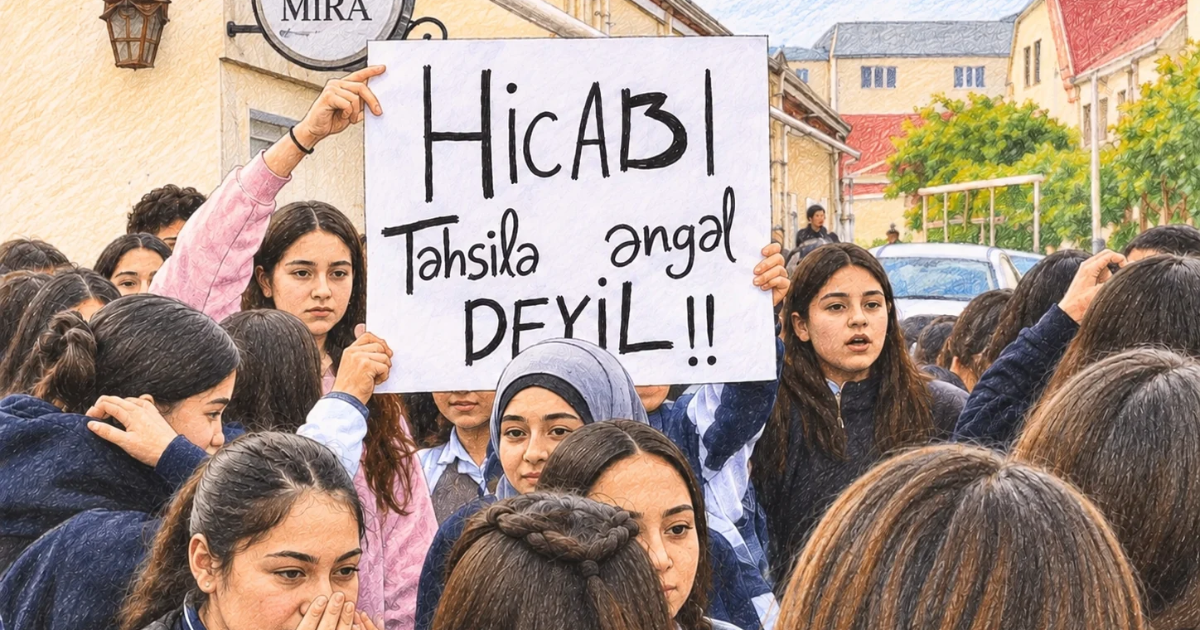
Azerbaijan is home to approximately 96% Muslims. Nevertheless, a new dress code for schools has launched a controversial debate on the issue of religion, state control, and personal freedom. In October 2026, reports spread that pupils and teachers wearing the hijab were being refused entry to state schools, and protests, arrests, and foreign criticism followed [1][2][3]. The line started with the uniforms but has now expanded to a larger question: just how far a secular government can go in regulating faith inside public institutions, and who gets to decide what the nation looks like.
The rules themselves are short. On 21 September 2026 the Cabinet of Ministers issued Resolution No. 309, which changed school-uniform requirements, and on 6 October it followed with Decision No. 325, setting dress standards for staff in state schools [4]. The word hijab appears in neither. The teacher rules point to the secular nature of education and leave headteachers in charge of making sure staff comply [4]. In practice, accounts emerged of girls in headscarves being stopped at classroom doors and of teachers meeting the same barrier [2][3]. Deutsche Welle noted that the text never tells schools to turn away pupils who cover their hair, so much depends on how individual administrators read the rules [1]. JAMnews adds that some schools have leaned on women teachers to take off the scarf or leave their jobs [5]. Defenders of the policy say common dress protects order and keeps schooling secular. Opponents ask why a child should lose lessons when no written ban exists.
The cost falls on particular people. Gulshan Aliyeva, who has taught English for 23 years, told Al Jazeera that staff would not let her into her school while she wore a headscarf, and that her daughter was also sent away [2]. Protests brought arrests. The Interior Ministry put the number held in Baku on 12 October at 37, though independent outlets reported higher totals that the authorities did not confirm [5]. Amnesty International called the restrictions discriminatory, urged the release of peaceful protesters, and raised alarm over the treatment of detainees and of an activist who had tried to arrange online classes for excluded girls [6]. By 27 October, Human Rights Watch was still recording exclusions and detentions, with no clear count of affected pupils or of people remaining in custody [3]. The episode deals with all three aspects of schooling, religious freedom, and speech & assembly. It also reveals a simple fact about the government. A policy of uniformity must have a solid legal basis and have responsible individuals accountable for its implementation, especially in determining who can access a public service. The absence of a decree about the hijab does not resolve the issue. Unspecific language gives local officials too much leeway and leaves families in the dark about what is and is not permitted, and where they might appeal.
The attitude of Azerbaijan towards religion was shaped by the Soviet regime. The state of the Soviet Union encouraged atheism and had a tight grip on the religious institutions; however, religious belief continued to exist within families and neighbourhoods. The republic retained a secular constitution after it became independent in 1991, and public religious life over time began to re-emerge. Much of the argument today revolves around a controversial hijab issue in secondary schools in 2010. The political scientist Galib Bashirov explains how the headscarf in post-Soviet Azerbaijan got embroiled in competing notions of modernity, national identity, and foreign influence [7]. Those who believe in strict secularism believe that it is a symbol of independence and modern statehood, a wall of separation between public institutions and the pressure of religion. Others consider a headscarf a private expression of faith which ought not to be a price for gaining entry to a classroom or an opportunity for a job. There is a difference in the meaning of the word secularism in everyday life between both camps.
The regional political climate shades the narrative and cannot be understood as its cause. The political system established in Iran is rooted in Shia Islam, while Azerbaijan maintains a secular system and has expressed concern about foreign interference in religious circles. Those events don't necessarily show Tehran was behind the protests or that the school regulations were meant to resist moves by Tehran. But the conflict with Armenia remains a sensitive issue in which sovereignty and unity are issues, and there is no direct link to the hijab measures, so to claim one would be going against the grain of the evidence. Türkiye is a more direct player. The restrictions were criticized by Turkish politicians, while the Azerbaijani authorities responded with statements on the importance of not interfering in each other's affairs. The exchange garnered attention between the two governments, which have close strategic relationships. It also illustrates how a domestic educational policy can become a diplomatic policy without explaining the motivation behind the decision for the policy.
Coverage has split along similar lines. Al Jazeera follows affected families and teachers [2], JAMnews looks at what happens inside school gates [5], and The New Arab concentrates on religious freedom and the call for clearer law [8]. They reveal a gap between what the government claims it does want and what those impacted experience in their daily lives.
The case raises a larger issue: Can a secular state remain neutral without unwarranted limitations on religion? History is important for Azerbaijan's political identity because of secularism, but it does not provide any justification for a particular policy. The actual issue isn't whether or not the nation should remain secular. It’s all about reading, rules, and citizens who can question decisions that restrict their rights - secularism. Any settlement should be based on clear law, accountable administration, and uninterrupted schooling. If, in the name of neutrality, a policy is formulated that seems to be an attempt to control belief, it will hurt the trust that secular institutions rely upon. The stakes for Azerbaijan are public trust in and respect for the state, and for individual pupils and teachers, their rights. In other nations where debates on neutrality are ongoing, the message is that this concept is evaluated in classrooms, not just in the constitution.
Md. Nahid Hasan, Research Intern at CGS
Views in this article are author's own and do not necessarily reflect on CGS policy
References
[1] Aghayev, I., & Scheider, M. (2026, October 16). Protests against hijab ban in Azerbaijan: Why are children involved? Deutsche Welle. https://amp.dw.com/en/hijab-ban-at-schools-in-azerbaijan-whats-behind-the-rare-wave-of-protests/a-79683716
[2] Gogia, G. (2026, October 27). Azerbaijan’s hijab restrictions exclude girls from school. Human Rights Watch. https://www.hrw.org/news/2026/10/27/azerbaijans-hijab-restrictions-exclude-girls-from-school
[3] Kazimov, S. (2026, October 14). Tensions with teachers, pupils and Turkiye: Inside Azerbaijan’s hijab row. Al Jazeera. https://www.aljazeera.com/news/2026/10/14/tensions-with-teachers-pupils-and-turkiye-inside-azerbaijans-hijab-row
[4] Azerbaijan Cabinet of Ministers. (2026). Teacher clothing requirements [Government regulation]. https://e-qanun.az/framework/62720
[5] JAMnews. (2026, October 12). ‘Take off your hijab and come into class’: What is happening in Azerbaijan’s schools? https://jam-news.net/take-off-your-hijab-and-come-into-class-what-is-happening-in-azerbaijans-schools/
[6] Amnesty International. (2026, October 16). Azerbaijan: Stop denying access to education through discriminatory hijab restrictions and release peaceful protesters. https://www.amnesty.org/en/latest/news/2026/10/azerbaijan-stop-denying-access-to-education-through-discriminatory-hijab-restrictions-and-release-peaceful-protesters/
[7] Bashirov, G. (2020). The politics of the hijab in post-Soviet Azerbaijan. Nationalities Papers, 48(2), 357–372. https://doi.org/10.1017/nps.2018.81
[8] Hamed, A. (2026, October 23). ‘I have a right to study’: The Azerbaijani schoolgirls shut out of class over their hijabs. The New Arab. https://www.newarab.com/features/hijab-ban-azerbaijan-raise-fears-over-religious-freedom