
Albania's Unfinished Transition: From Hoxha's Isolation to the "Flamingo" Revolt
Afsana Mimi | 31 October 2026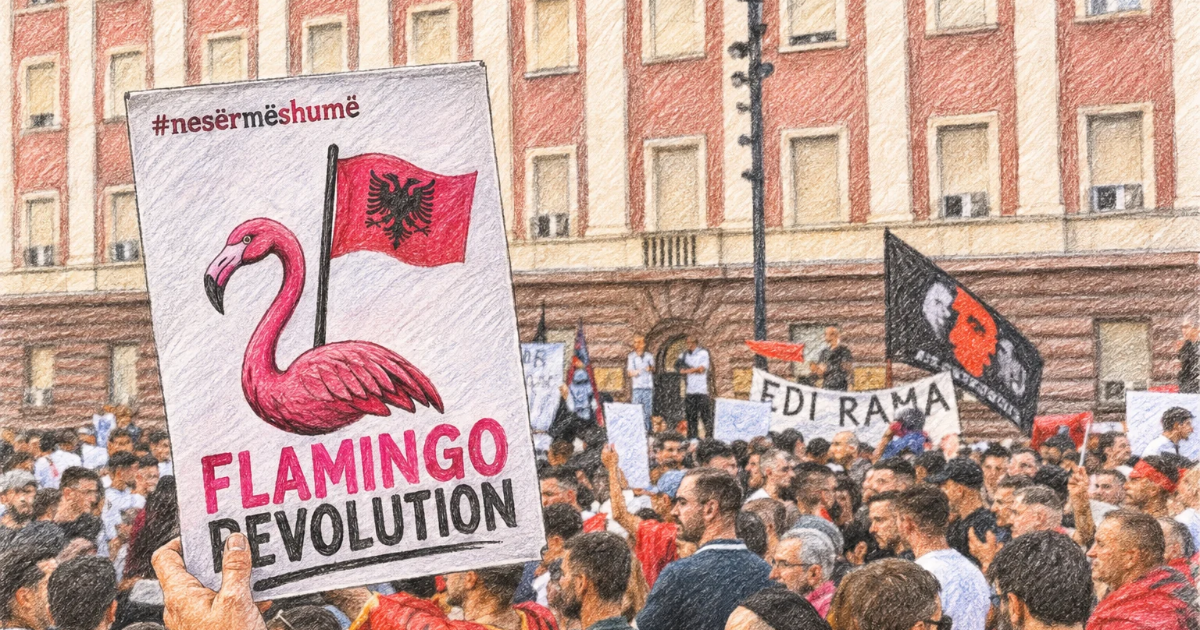
From environmental movement to future protection, this is Albania's scenario: a Southeast European state where people have become concerned for their lives and their rights. People knew they needed to protect their landscape, but they didn't know Gen Z would soon change the agenda. The underlying causes of this unrest include political polarisation, allegations of corruption, economic dissatisfaction, unemployment, and youth migration.[1]This has been witnessed over time, not only in Albania but also across Europe. Albania is governed by a left-wing government, the Socialist Party of Albania (PS), and Edi Rama, fourth-term prime minister, has faced the most fragile period of his political career, including in terms of popularity.
Historical Roots: A state built on fragility
To understand the current political uncertainty of Albania, it is crucial to look back at the communist era when authoritarian ruler Enver Hoxha established the most restrictive political system. From 1944 until the collapse of communism in 1991, the country had seen political repression, economic isolation, restrictions on individual freedoms, and limited contact with the outside world. The government maintained extensive control over economic and political institutions, leaving Albania among Europe's poorest and most marginalised countries.[2]
After the death of Hoxha in 1985, Albania's political and economic situation developed gradually. After that, the most demanded change happened there; from the perspective of people's demands, they experienced the collapse of communism. Subsequently, Albania introduced multiparty politics, which commenced the transition towards democracy and a market economy. In 1992, the Democratic Party won the elections, and Sali Berisha became the country's first democratically elected president.[3]
However, it would be unreal if the democratic transition immediately produced political stability or economic tolerance. So the country faced weak institutions, inadequate financial regulation, unemployment, and widespread poverty. One of the most serious crises occurred in 1997 when several large pyramid investment schemes collapsed, destroying the savings of thousands of citizens. This fuelled public anger, which further developed into armed unrest, and government authority collapsed. This experience demonstrated how economic mismanagement and institutional weaknesses could generate serious political instability.[4]
Political Rivalry Between Sali Berisha and Edi Rama
Albania’s politics are actually dominated by two political parties: the socialist party of Albania (PS), left-centred, and the democratic party of Albania (PD), right-centred. The Socialist Party is led by the chair, Edi Rama, and the left wing by Sali Berisha.
From 1992 to 1997, Berisha served as president and subsequently became prime minister from 2005 to 2013. Though Berisha was successful compared to the communist rule,but his political tenure also faced criticism over governance, corruption allegations, and disputed decisions.
Meanwhile, Edi Rama became prime minister in 2013 after the Socialist Party defeated Berisha's governing coalition. Rama had promised administrative modernisation, economic development, European integration, and improvements in public institutions. However, his government has subsequently faced repeated allegations concerning corruption, political patronage, and the concentration of power.[5]
This two-party clash has made Albania more underdeveloped and politically unstable. Instead of focusing on the state, they were concentrating on accusing each other. The conflict has also extended beyond the rivalry between Rama and Berisha. Investigations involving politicians from both political camps have generated debates about the independence of the judiciary and the credibility of political leadership. Consequently, public resentment increasingly concerns the political establishment as a whole rather than only the governing party.
February 2026: Corruption Allegations and Political Confrontation
At the beginning of 2026, political tensions arose as the opposition party accused the deputy prime minister, Belinda Balluku, of corruption. Albania's Special Prosecution Office had indicted Balluku over allegations of interference in public procurement procedures involving major infrastructure projects and favouring selected companies. Balluku denied the allegations, while an anti-corruption court suspended her from office. Prosecutors subsequently sought parliamentary approval to lift her immunity.[6]
This controversy escalated the confrontation between Rama's Socialist Party and Berisha's Democratic Party. The right-centred followers demanded Rama's resignation, arguing that the allegations reflected broader problems of corruption and political accountability. As a result, political instability began to intensify. During demonstrations in Tirana, protesters threw petrol bombs and fireworks towards the prime minister's office, while police responded with tear gas and water cannons.[7] This part is significant because it demonstrates that anti-government dissatisfaction existed before the environmental protests of May. Corruption allegations and the conflict between political leaders had already created a highly confrontational political atmosphere.
May 2026: Environmental Controversy and the Flamingo Revolution
The next major occurrence happened in May 2026 for the protection of the environment. The reason behind this was a deal between the Rama government and Jared Kushner's investment firm to establish a luxury tourism development sector in the sensitive area. This project involved Sazan Island and the coastal area near Zvërnec, close to the environmentally sensitive Vjosa-Narta protected landscape. This illegal site triggered concerns about potential damage to wetlands, migratory bird habitats, flamingos, marine ecosystems, and coastal biodiversity. Thousands of protesters demanded the cancellation of the project, demanding that environmental protection and public interests should not be sacrificed for luxury tourism investment. The flamingo emerged as the movement's symbol, giving rise to the name "Flamingo Revolution".[8] Over time, this environmental protest converted into political uprisings; demonstrators were questioning the legality of the investment agreements and the validity of this project. According to the Centre for Eastern Studies, the movement gradually expanded from environmental resistance towards demands for Rama's resignation, investigations into corruption allegations, and changes to Albania's economic and political structures. Thus, the environmental controversy acted as a catalyst for grievances that had accumulated over many years.
October 2026: Student Mobilisation and Nationwide Clashes
From environmental protection to future security, this is the ultimate line for Albania’s current situation. The protests enlarged significantly in October 2026 when the youth, mostly university and school students, joined to protect their rights concerning rising tuition fees, inadequate university infrastructure, poor dormitory conditions, limited financial support, and unemployment. On 14 October, major demonstrations in Tirana escalated into violent confrontations. Protesters attacked government buildings and bank branches, damaged businesses, and clashed with police. Security forces responded with tear gas and other crowd-control measures (Reuters, 2026). The joining of youth for their rights, along with the common people, demonstrates that all problems have a straight line that is eventually sparked by the ignorance of the government. [9]
Instead of a single isolated incident, it is clear that Albania’s 2026 clashes were the outcome of compiled historical, economic, and environmental grievances. Furthermore, the crisis demonstrates how accumulated public grievances can converge around a particular controversy and develop into a nationwide challenge to political authority.
Afsana Mimi, Research Intern at CGS
Views in this article are author's own and do not necessarily reflect on CGS policy
References
[1]OSW Centre for Eastern Studies. (2025, May 15). Albania: A fourth term for Prime Minister Edi Rama.https://www.osw.waw.pl/en/publikacje/analyses/2025-05-15/albania-a-fourth-term-prime-minister-edi-rama
[2] . International Monetary Fund (IMF). (1999). The rise and fall of Albania's pyramid schemes.https://www.imf.org/external/pubs/ft/wp/1999/wp9998.pdf
[3] . United States Department of State. (2003). Background note: Albania.https://2009-2017.state.gov/outofdate/bgn/albania/33653.htm
[4] Jarvis, C. (2000). The rise and fall of Albania's pyramid schemes. Finance & Development, 37(1). International Monetary Fund.https://www.imf.org/external/pubs/ft/fandd/2000/03/jarvis.htm
[5] OSW Centre for Eastern Studies. (2025, May 15). Albania: A fourth term for Prime Minister Edi Rama.https://www.osw.waw.pl/en/publikacje/analyses/2025-05-15/albania-a-fourth-term-prime-minister-edi-rama
[6] . Reuters. (2026, February 20). Graft allegations spark clashes in Albania between police and protesters.https://www.reuters.com/world/graft-allegations-spark-clashes-albania-between-police-protesters-2026-02-20/
[7] . Reuters. (2026, June 8). Albania's Rama vows to push on with Kushner-linked luxury resort despite protests.https://www.reuters.com/world/albanias-rama-vows-push-with-kushner-linked-luxury-resort-despite-protests-2026-06-08/
[8] . Reuters. (2026, October 14). Fire breaks out at Albania's Education Ministry during student protest.https://www.reuters.com/
[9] . Al Jazeera. (2026, October 20). 'Horizontal revolt': Why Albania's young protesters want PM Rama to go.https://www.aljazeera.com/news/2026/10/20/horizontal-revolt-why-albanias-young-protesters-want-pm-rama-to-go