
Khyber Pakhtunkhwa in Crisis: When Security, Politics and Federalism Collide
Fawzia Afrin | 31 October 2026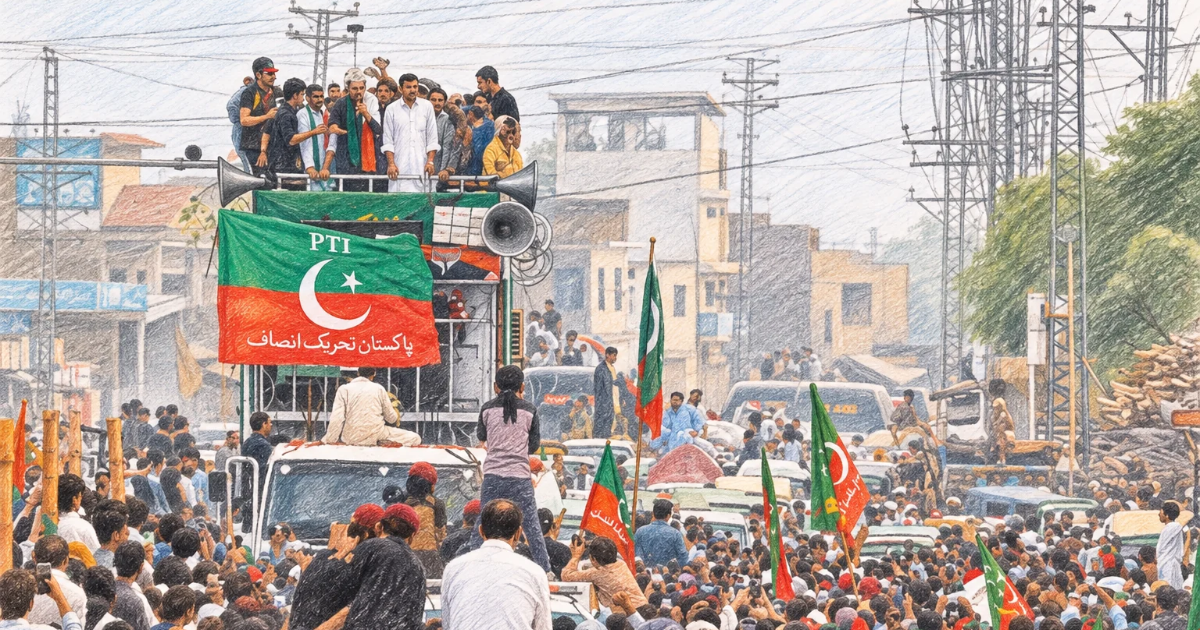
Khyber Pakhtunkhwa has again become the epicenter of one of Pakistan’s most consequential political and security crises. It is one of the areas worst affected by militancy, the principal stronghold of the Pakistan Tehreek-e-Insaf (PTI) and now the center of the confrontation between Imran Khan’s movement and the federal authorities. These roles have collided.
PTI’s mobilization and long march coincided with deepening disagreement between Islamabad and the provincial government over counterterrorism. By 11 October, the federal government had imposed emergency measures and governor’s rule, arguing that the provincial administration had been deliberately inactive against terrorism.[1]
The federal government’s security concerns cannot simply be dismissed as political rhetoric. KP has experienced a serious escalation in terrorism and counterterrorism violence. According to the Centre for Research and Security Studies, KP recorded 475 violence-linked fatalities during the second quarter of 2026, accounting for more than 61 percent of Pakistan’s total during that period.[2] It gives Islamabad a credible basis for arguing that KP faces an extraordinary security challenge. Yet the central question is not whether terrorism exists. It is whether deteriorating security justified displacing the elected provincial executive and concentrating authority in the federal government.
The dispute had already moved well beyond routine differences over security policy before governor’s rule was imposed. The federal government accused the PTI-led provincial administration of failing to cooperate adequately against militancy. Islamabad increasingly portrayed the provincial leadership not merely as a political opponent but as incapable, or unwilling, of discharging its security responsibilities. PTI leaders argued that repeated military operations had failed to deliver lasting peace and demanded greater provincial involvement in decisions affecting KP. During the October protest March, Chief Minister Sohail Afridi publicly declared that he would oppose another military operation in the province.[3]The KP crisis shows how a security emergency can become inseparable from a struggle over political legitimacy and federal power.
Imran Khan remains central to Pakistani politics even while imprisoned. KP Chief Minister Sohail Afridi tied the provincial mobilization directly to demands concerning Khan. Afridi announced a long march; mobilization began on 4 October, and Swabi became an important staging point. The march was organized primarily to demand the release of imprisoned PTI founder Imran Khan.[4]This placed the KP government in an unusual position. The provincial chief minister was simultaneously responsible for governing one of Pakistan’s most security-sensitive regions and leading a nationwide opposition mobilization against the federal government. This also complicates the federal government’s justification for its subsequent actions. Reuters reported that hundreds of PTI activists and three of Khan’s sisters had already been detained ahead of the planned march.[5]
On 11 October, President Zardari approved emergency and governor’s rule under Articles 232 and 234 of Pakistan’s Constitution. Governor Faisal Karim Kundi assumed provincial executive functions with the assistance of an advisory council, while a separate administrative mechanism was established for 12 particularly sensitive districts.[6]
These are exceptional constitutional powers. Article 234 permits the president, following a governor’s report, to assume provincial governmental functions when the province can no longer be governed in accordance with the Constitution.[7] The provision is therefore intended for circumstances in which ordinary provincial government has effectively broken down, not when Islamabad strongly disagrees with a provincial administration.
Parliament subsequently endorsed the proclamations amid opposition protests.[8] PTI challenged emergency and governor’s rule before the Peshawar High Court, arguing that the measures were unconstitutional.[9] The resulting dispute reaches beyond PTI and the current federal coalition. If federal intervention is invoked too readily, provincial autonomy becomes vulnerable whenever political and security disagreements overlap.
The crisis became more controversial when the suspension of provincial authorities was followed by detentions. Federal Minister of State for Interior Talal Chaudhry confirmed that Sohail Afridi and several cabinet members had been taken into preventive custody.[10] The detention of political leaders therefore creates a serious perception problem for Islamabad. When security measures simultaneously weaken an armed insurgency and incapacitate the government’s principal political opponent, the authorities must provide particularly persuasive evidence that coercive powers are being exercised for security rather than partisan objectives.
The confrontation was not inevitable. Negotiations between PTI and the federal government continued immediately before the march, but the sides failed to resolve their differences, particularly over counterterrorism policy and access to Imran Khan. The failure of negotiations converted a negotiable political dispute into a constitutional-security confrontation. With fewer political mechanisms available, institutions relied increasingly on coercive and legal instruments.
KP is caught in a feedback loop in which security deterioration intensifies political confrontation, while political confrontation makes coherent security governance more difficult. Islamabad faces a genuine security challenge. Political confrontation may weaken the institutional cooperation needed to meet it. PTI may legitimately raise constitutional concerns, yet using provincial authority within a national mobilization strategy further complicates governance. KP currently suffers deficits in both areas.
The crisis in Khyber Pakhtunkhwa is therefore about considerably more than one province or one political party. It poses a wider question about how Pakistan manages threats in a deeply polarized political system.
Khyber Pakhtunkhwa has consequently become a test not merely of Pakistan’s capacity to defeat militancy, but of whether its constitutional order can withstand intense security pressure. Unless Islamabad and its political opponents separate legitimate counterterrorism requirements from their struggle for political power, measures intended to restore stability may instead deepen the crisis of legitimacy that makes lasting stability increasingly difficult.
Fawzia Afirn is a Research Intern at CGS
Views in this article are author's own and do not necessarily reflect on CGS policy
References
[1]Reuters. (2026, October 11). Pakistan imposes emergency rule over Imran Khan’s provincial government. https://www.reuters.com/world/asia-pacific/pakistan-president-imposes-emergency-province-ruled-by-ex-pm-imran-khans-party-2026-10-11/
[2]Centre for Research and Security Studies. (2026). Pakistan records downtick in violence, but KP fatalities surge 53%. https://crss.pk/pakistan-records-downtick-in-violence-but-kp-fatalities-surge-53/
[3]Dawn. (2026, October 7). Will not allow military operations, KP CM tells march participants in Khyber. https://www.dawn.com/news/2035434
[4]Dawn. (2026, October 16). PHC to hear PTI chairman’s plea against emergency, governor’s rule in KP. https://www.dawn.com/news/2037576
[5]Reuters. (2026, October 11). Pakistan imposes emergency rule over Imran Khan’s provincial government. https://www.reuters.com/world/asia-pacific/pakistan-president-imposes-emergency-province-ruled-by-ex-pm-imran-khans-party-2026-10-11/
[6]Radio Pakistan. (2026, October 11). President promulgates emergency, governor’s rule in KP. https://radio.gov.pk/11-10-2026/president-promulgates-emergency-governors-rule-in-kp
[7]National Assembly of Pakistan. (n.d.). The Constitution of the Islamic Republic of Pakistan (Art. 234). https://www.na.gov.pk/uploads/documents/1495426115_559.pdf
[8]The Express Tribune. (2026, October 15). Parliament’s joint session endorses K-P emergency, governor’s rule amid opposition uproar. https://tribune.com.pk/story/2634969/resolution-to-ratify-k-p-emergency-governors-rule-tabled-in-parliaments-joint-session
[9]Dawn. (2026, October 4). PTI unveils five-day protest march plan. https://www.dawn.com/news/2034587/pti-unveils-five-day-protest-march-plan
[10]Reuters. (2026, October 12). Pakistan province leaders of ex-PM Imran Khan’s party detained, junior minister says. ThePrint. https://theprint.in/world/pakistan-province-leaders-of-ex-pm-imran-khans-party-detained-junior-minister-says/3068975/