
From Revolution to Resistance: France’s Unfinished Social Contract
Sharaf AnjumProva | 31 October 2026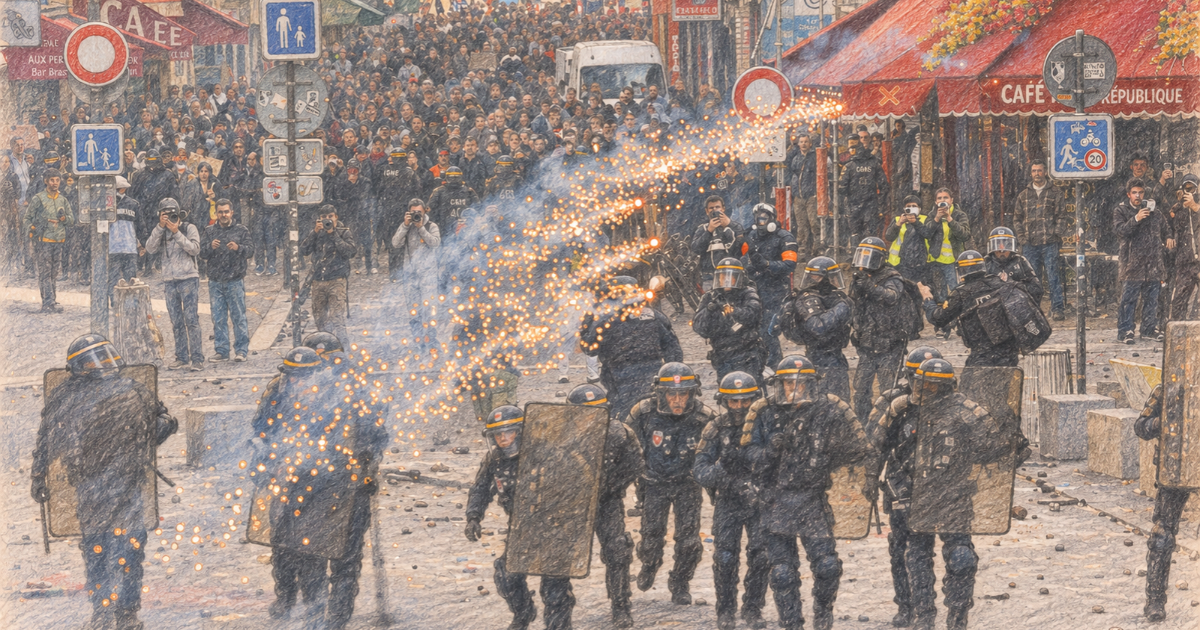
On October 17, 2026, Ahmed Benmezroua, a 25-year-old freelance photographer, arrived in Paris to document a demonstration. Near Place de la République, an explosion changed his life. A fragment, believed to have come from a police grenade, tore through his thigh, severing his femoral artery and causing life-threatening blood loss. Protesters and volunteer medics helped save him before emergency surgery.[i] Attending a demonstration for the first time, Benmezroua had come to photograph the gathering, not to participate in confrontations. His lawyer later filed a criminal complaint alleging attempted homicide and serious violence by public officials.[ii]Responsibility remains subject to investigation, but his injury poses a question that reaches beyond one police operation: what happens when the institutions entrusted with protecting citizens become a source of fear?
France’s student-led protests began in September with demands for adequate teachers, manageable classrooms, and fairer university admissions. The movement then abruptly spread across the country as more than 1,000 schools joined by October 1.[iii] On October 6, the number of people was approximately 266,000 nationwide, according to the Interior Ministry, while organizers estimated 450,000 participants.[iv] By October 17, the protestors were also raising concerns over rising living costs, economic insecurity, and police actions, drawing around 800,000 demonstrators according to organizers.[v] These demonstrations represent more than opposition to a particular government policy. They reveal a strain in the social contract as citizens expect the state to protect their rights, provide essential services and respond to their concerns.
The question of trust between citizens andgovernment has deep roots in French political history. The 1789 French Revolution challenged the belief that established authority deserved unquestioning obedience. The Declaration of the Rights of Man and of the Citizen established that political power belongs to the nation and should be exercised for the benefit of its people. Article 12 states that public force exists for everyone’s benefit, and Article 15 affirmed society’s right to demand accountability from public officials.[vi]With those principles on the books, it is difficult to ignore today’s controversy over policing.
The philosophical foundations of this transformation came from a broader questioning of inherited authority. Rene Descartes emphasized independent reasoning with his famous line, “I think, therefore I am,”[vii] while Edward Herbert of Cherbury questioned the exclusive authority of established religious institutions in determining religious truth.[viii] John Locke developed the argument that legitimate government needs the consent of the governed and must protect individual rights[ix], whereas Jean-Jacques Rousseau further emphasized popular sovereignty. Their ideas differed, buttogether they contributed to a broader intellectual transformation in which political authority increasingly required justification rather than acceptance without questions.
Social contract theory provides a practical framework for understanding this relationship between citizens and the state. Citizens accept state authority and fulfil their civic responsibilities,and in return they expect security, fair treatment, opportunity and political representation.In a modern welfare state, these expectations expand to education, healthcare and socioeconomic protection. [x]Winning elections may give a government the authority to govern, but maintaining public trust requires more than an electoral mandate. When institutions repeatedly overlook people’s concerns, frustration can deepen into distrust of the political system itself.
Considering the starting point of the ongoing movement, the demonstrations began at a school in Creteil, where unfilled teaching positions ignited wider anger about staffing shortages, overcrowding, deteriorating buildings and the Parcoursup university admissions system. Public education is central to France’s republican promise that a child’s future should not be determined by family wealth or background. Yet the Organisation for Economic Co-operation and Development’s (OECD)Programme for International Student Assessment (PISA) 2025 findings reveal a 100-point science performance gap between socioeconomically advantaged and disadvantaged students in France, exceeding the OECD average of 85 points. [xi]When schooling appears to reproduce inequality rather than overcome it, the grievance is no longer simply about classroom conditions. It concerns the state’s promise of equal opportunity.
Economic pressures sharpen that sense of betrayal. Housing costs, insecure employment, strained household budgets and uneven access to public services make young people question whether educational qualifications will lead to a stable future. Working-class households may feel they are expected to meet growing obligations without receiving comparable economic security. These pressures overlap. A student concerned about university admissions may also worry about employment and housing, while parents demanding better schools may simultaneously struggle with declining purchasing power. Separate grievances gradually converge into a broader perception of institutional failure.
The trust deficit predates the present protests. Sciences Po’s February 2026 Political Trust Barometer found that only 22 percent of French respondents expressed confidence in politics, while trust in the president and National Assembly stood at 18 and 20 percent respectively. Yet 82 percent remained attached to democracy.[xii] This distinction matters. Distrust of political institutions does not necessarily indicate rejection of democratic governance. Rather, citizens may believe that established political channels are insufficiently responsive to their concerns. Street mobilization then becomes an alternative means of demanding accountability.
The Yellow Vest movement offers a revealing parallel. Beginning in 2018 over fuel taxes, it developed into a nationwide protest against declining purchasing power, regional inequalities, and political detachment.[xiii] Today’s demonstrations began in classrooms rather than at traffic roundabouts, but both reflect a belief that decision-makers are disconnected from everyday socioeconomic realities. Their recurrence does not establish an uninterrupted crisis but suggests that successive governments have struggled to address deeper questions of fairness, representation and the distribution of economic burdens.
Police conduct has intensified these tensions. Benmezroua’s injury was not the only severe case. In October, a 15-year-old student lost a hand following an explosion of a police grenade in Lens, while in Tours, a 16-year-old lost sight in one eye involving a suspected police projectile. Le Monde documented numerous serious injuries and reported that by 28 October, police and gendarmerie inspectorates are handling 83 investigations.[xiv] Some demonstrations also involved attacks on officers and property damage that includes the historic 143-year-old Limoges Town Hall fire set by masked rioters.[xv] The state does have a legitimate responsibility to maintain public safety, but that responsibility requires proportionate force and credible accountability, not immunity from scrutiny. When citizens suffer life-changing injuries as they exercise their right to protest, the state’s use of coercive power becomes a question of democratic legitimacy.
The government has offered concessions, including smaller classes, loans for school renovations, additional higher-education places and plans to replace Parcoursup. Student representatives, however, consider these measures insufficient.[xvi] France’s fiscal constraints are genuine,as public debt and deficits limit expenditure. Yet restoring institutional confidence requires more than announcing reforms or dispersing crowds. It demands action against persistent inequalities, room for meaningful public engagement and accountability for excessive use of force.
France has experienced revolutions, uprisings and mass protests across its modern history from 1789 and 1848 to 1968, 2018 and the current unrest. These moments were neither identical nor part of predictable historical cycle. What connects them is a recurring confrontation over the meaning of political authority and the trust and expectations placed upon by people.
The irony of the present crisis is that the French Republic is being challenged in the language of its own founding ideals- liberty, equality, accountability and the right of citizens to demand better from the government. The deeper challenge is not simply to persuade protestors to return home but to restore their confidence in public institutions.
France does not need to repeat the Revolution of 1789. It needs its institutions to remember why that revolution became necessary in the first place.
Sharaf Anjum Prova is a Research Assistant at CGS
Views in this article are author's own and do not necessarily reflect on CGS policy
References
1 Mediapart. (2026, October 23). "I thought I was dying": investigation into the wounded of October 17.
https://www.mediapart.fr/journal/france/231026/j-ai-cru-mourir-enquete-sur-les-blesses-du-17-octobre
2 Le Parisien. (2026, October 23). October 17th Protests: Complaint filed for "attempted homicide" of a photographer injured by a police grenade.
https://www.leparisien.fr/paris-75/mobilisations-du-17-octobre-plainte-pour-tentative-dhomicide-dun-photographe-blesse-par-une-grenade-policiere-23-10-2026-BUFQ6QLSHZCXVMCZASMFVZU4HI.php
3 Le Monde. (2026, October 2). High school student protests spread across France as tensions escalate.
https://www.lemonde.fr/en/france/article/2026/10/02/high-school-student-protests-spread-across-france-as-tensions-escalate_6758168_7.html
4 Le Monde. (2026, October 7). French high school protests grow and draw widespread support.
https://www.lemonde.fr/en/france/article/2026/10/07/high-school-students-movement-protests-grow-and-draw-widespread-support_6758337_7.html
5 Associated Press. (2026, October 17). Clashes, fires and looting break out as protesters rally across France, joining students.
https://apnews.com/article/france-school-protests-yellow-vest-44b9d3ba91ffad4029f975dced7e31cb
6 Élysée. (n.d.). The Declaration of the Rights of Man and of the Citizen.
https://www.elysee.fr/en/french-presidency/the-declaration-of-the-rights-of-man-and-of-the-citizen
[vii] Stanford Encyclopedia of Philosophy. (2023). Descartes’ epistemology.
https://plato.stanford.edu/entries/descartes-epistemology/
[viii] Encyclopedia.com. (n.d.). Herbert of Cherbury, Edward.
https://www.encyclopedia.com/religion/encyclopedias-almanacs-transcripts-and-maps/herbert-cherbury-edward
[ix] Stanford Encyclopedia of Philosophy. (2020). Locke’s political philosophy.
https://plato.stanford.edu/entries/locke-political/
[x] Stanford Encyclopedia of Philosophy. (2021). Contemporary approaches to the social contract.
https://plato.stanford.edu/entries/contractarianism-contemporary/
[xi] OECD. (2026, September 8). PISA 2025 results (Volume I): France.
https://www.oecd.org/en/publications/pisa-2025-results-volume-i-country-notes_2d4ff9ea-en/france_6d229453-en.html
[xii] Sciences Po CEVIPOF. (2026, February 9). CEVIPOF 2026 Political Trust Barometer: Trust in politics collapses, proximity becomes a refuge.
https://www.sciencespo.fr/cevipof/fr/actualites/barometre-de-la-confiance-politique-cevipof-2026-la-confiance-s-effondre-en-politique-la-proximite-fait-figure-de-refuge/
[xiii] Reuters. (2019, January 18). Explainer: 'Yellow vest' crisis exposes limits of French welfare system.
https://www.euronews.com/2019/01/18/explainer-yellow-vest-crisis-exposes-limits-of-french-welfare-system
[xiv] Le Monde. (2026, November 3). Over the course of a month of social unrest, protesters have suffered serious injuries: “I’m screaming, I’m panicking-it feels like I’ve lost my leg”.
https://www.lemonde.fr/societe/article/2026/11/03/au-fil-d-un-mois-de-mobilisations-sociales-des-manifestants-victimes-de-graves-blessures-je-crie-je-panique-j-ai-l-impression-que-j-ai-perdu-ma-jambe_6805525_3224.html
[xv] BBC News. (2026, October 23). Ruins of Limoges city hall a symbol of France divided by national protests.
https://www.bbc.com/news/articles/cxyvrged14d0o
[xvi] Reuters. (2026, October 26). French students vow more protests despite Macron government’s concessions.
https://www.investing.com/news/world-news/french-student-protesters-say-government-offered-them-deal-but-they-want-more-4973382